What Is Heparin Injection 5000 IU?
Heparin is a fast-acting anticoagulant, a medicine that stops blood from clotting when it shouldn’t. Hospitals have used it for decades, and it remains one of the basic drugs in every ICU, cardiac unit, operation theatre and dialysis centre.
Its biggest advantage is speed. Given into a vein, heparin starts working almost immediately, which is why doctors turn to it when a patient has, or is at high risk of, a dangerous clot. It is also easy to reverse: if a patient bleeds, an antidote called protamine sulfate can switch its effect off quickly.
Heparin doesn’t dissolve a clot that has already formed. What it does is stop the clot from growing and prevent new ones, while the body slowly breaks down the existing clot on its own.
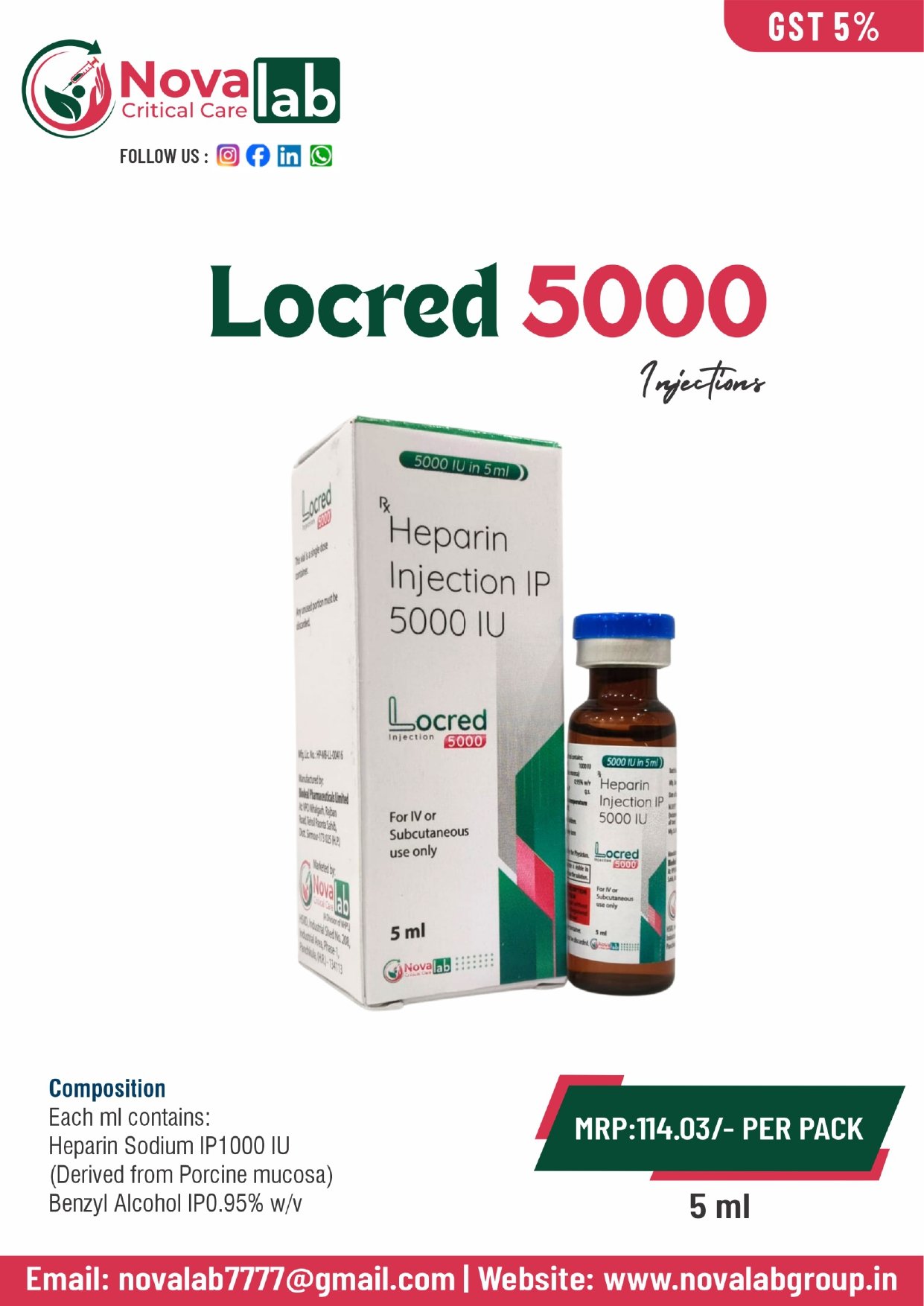
Novalab Critical Care, the injectables division of Novalab Healthcare Pvt. Ltd., markets Heparin Sodium Injection IP 5000 IU under the brand name Locred 5000. It is manufactured at WHO-GMP certified facilities and is available for PCD pharma franchise and third-party manufacturing.
Locred 5000 Injection Composition and Product Details
| Ingredient (per ml) | Quantity | Standard |
|---|---|---|
| Heparin Sodium (derived from porcine mucosa) | 1000 IU | IP |
| Benzyl Alcohol (preservative) | 0.95% w/v | IP |
| Detail | Information |
|---|---|
| Brand Name | Locred 5000 |
| Strength | 5000 IU in 5ml (1000 IU/ml) |
| Dosage Form | Injection (multi-dose vial) |
| Pack Size | 5ml vial |
| Route | Intravenous (IV) or Subcutaneous (SC) only |
| Prescription | Rx (prescription only) |
| Therapeutic Category | Anticoagulant |
| Marketed by | Novalab Critical Care (Novalab Healthcare Pvt. Ltd.) |
Heparin Injection Uses
Heparin is used to prevent and treat blood clots in situations such as:
- Deep vein thrombosis (DVT): clots in the deep veins, usually of the legs
- Pulmonary embolism: a clot that has travelled to the lungs
- Preventing clots after surgery, especially orthopaedic, abdominal and cancer surgery, and in patients who are bedridden for long
- Heart attack and unstable angina, along with other heart medicines
- Atrial fibrillation with a risk of clots travelling to the brain or limbs
- Clots in the arteries of the arms and legs
- Keeping blood from clotting during dialysis, heart surgery and blood transfusions
- Disseminated intravascular coagulation (DIC) in selected cases
Heparin Injection Uses in Hindi
हेपारिन इंजेक्शन एक खून पतला करने वाली (एंटीकोएगुलेंट) दवा है, जो शरीर में खतरनाक खून के थक्के (क्लॉट) बनने से रोकती है। इसका उपयोग अस्पताल में इन स्थितियों में किया जाता है:
- पैरों की नसों में खून का थक्का (डीवीटी)
- फेफड़ों में खून का थक्का (पल्मोनरी एम्बोलिज़्म)
- ऑपरेशन के बाद या लंबे समय तक बिस्तर पर रहने वाले मरीज़ों में थक्का बनने से रोकने के लिए
- हार्ट अटैक और अनस्टेबल एंजाइना में
- डायलिसिस और हार्ट सर्जरी के दौरान खून को जमने से रोकने के लिए
यह इंजेक्शन केवल नस (IV) में या त्वचा के नीचे (सबक्यूटेनियस) लगाया जाता है, मांसपेशी में नहीं। इसे केवल डॉक्टर की देखरेख में ही दिया जाता है, क्योंकि इससे ब्लीडिंग का खतरा रहता है।
How Does Heparin Work?
The blood contains a natural protein called antithrombin, which slowly switches off clotting factors. Heparin attaches to antithrombin and makes it work around a thousand times faster. The two main clotting factors it blocks are thrombin and factor Xa, and without them, blood can’t form a firm clot.
Given into a vein, heparin acts within minutes. Given under the skin, it takes about 20 to 60 minutes to start working. Its effect wears off within a few hours of stopping, which gives doctors close control over a patient’s clotting.
Benefits of Heparin Injection
- Works within minutes when given IV, so it suits emergencies
- Short-acting, so the effect can be adjusted or stopped quickly
- Has a specific antidote (protamine sulfate) if bleeding occurs
- Can be used in patients with poor kidney function, unlike some newer blood thinners
- Doesn’t cross the placenta, which is why doctors often choose heparins during pregnancy
- Multi-dose 5ml vial allows dose adjustment for different patients
Heparin Injection Dosage and Administration
Heparin is given only by a doctor or nurse, and the dose is set for each patient. As a general guide:
- Preventing clots: commonly 5,000 IU under the skin every 8 to 12 hours
- Treating an existing clot: a loading dose into a vein, followed by a continuous IV drip. The drip rate is adjusted using a blood test called aPTT.
- Dialysis, heart surgery and other procedures: dosing follows the hospital’s protocol
How it’s given:
- IV: as a direct injection or as a continuous infusion
- Subcutaneous: into the fatty tissue of the belly, without rubbing the site afterwards
- Never into a muscle (IM). It can cause large, painful bruises.
Patients on heparin have regular blood tests to check clotting (aPTT) and platelet count.
Side Effects of Heparin Injection
The main side effect is bleeding. Watch for:
- Bleeding gums or nosebleeds
- Easy bruising, especially at injection sites
- Blood in the urine, or black or bloody stools
- Heavier periods
Other side effects can include pain or irritation at the injection site, skin rash, and changes in liver test results. Long-term use can lead to bone thinning and hair loss.
Rare but serious: heparin-induced thrombocytopenia (HIT), a sudden drop in platelets that can paradoxically cause new clots, usually 5 to 10 days after starting. Also severe bleeding, high potassium levels, and severe allergic reactions. These need urgent medical attention.
Who Should Not Be Given Heparin
Heparin should not be given to people who have:
- Active, uncontrolled bleeding
- A very low platelet count, or a past history of heparin-induced thrombocytopenia (HIT)
- An allergy to heparin or to pork-derived products
- Severe, uncontrolled high blood pressure
- Recent surgery or injury to the brain, spine or eye, or a recent bleed in the brain
Because this vial contains benzyl alcohol as a preservative, it should not be used in newborns or premature babies.
Precautions and Drug Interactions
- Other medicines that affect bleeding: aspirin, clopidogrel, painkillers like ibuprofen, warfarin and clot-busting drugs all raise the risk of bleeding when used with heparin.
- Spinal or epidural anaesthesia: there is a risk of bleeding around the spinal cord, so timing must be planned carefully.
- Older patients, especially women over 60, and patients with kidney or liver disease have a higher bleeding risk and need closer monitoring.
- Potassium: heparin can raise potassium levels, so these are checked in patients at risk.
- Pregnancy: heparin itself doesn’t cross the placenta, but doctors usually prefer a preservative-free form in pregnancy, as this vial contains benzyl alcohol.
- Porcine origin: this heparin is made from pig intestinal mucosa. Tell your doctor if this is a concern for religious or personal reasons.
- Overdose: protamine sulfate reverses heparin’s effect.
Storage Instructions
Store below 30°C, protected from light. Do not freeze. After the vial is first opened, follow the pack insert on how long it can be kept and used. Keep out of reach of children.
Heparin Injection PCD Franchise
Few injectables are as essential to a hospital as heparin. It’s used every day in ICUs, cardiac care units, cath labs, dialysis centres and operation theatres, and it’s on India’s National List of Essential Medicines. A hospital can’t run without it, so it’s never out of demand.
What makes heparin attractive for a distributor is how regular the orders are. Surgeons give it to prevent clots after operations, cardiologists use it in heart attacks, nephrologists use it in every dialysis session, and physicians use it for bedridden patients. Usage doesn’t depend on the season. It depends on how many patients the hospital admits, so orders stay steady month after month.
The best accounts for this product are multi-speciality hospitals, heart centres, dialysis units, orthopaedic and surgical hospitals, and nursing homes with ICU beds. If you’re new to injectables, see our list of top injectable PCD companies in India to understand how this segment works.
Add Our ICU and Emergency Injectables
The same ICU and emergency teams who order heparin also stock these Novalab Critical Care injections:
- Adrenaline Injection (Adernov), for cardiac arrest and severe allergic reactions
- Methylprednisolone 125mg Injection (Conipred 125), for severe inflammation, allergic emergencies and acute flare-ups
- Dexamethasone 4mg/ml Injection (Decred), a widely used steroid for allergy, swelling and shock
Become a Novalab Critical Care Partner
Reach us on +91 95705 99567 (call or WhatsApp) or through our contact page. Let us know the hospitals and districts you cover, and we’ll confirm monopoly availability, then help you build a starting list from our 150+ injectable products. You’ll need a valid drug license and GST registration, and orders ship from Panchkula, Haryana.
Novalab Critical Care has been part of Novalab Healthcare since 2014, with ISO 9001:2015 certification, WHO-GMP certified manufacturing and DCGI approved molecules. Partners get visual aids, product literature, MR bags and branded inputs. If you’re in the tricity area, read about our injectable PCD pharma franchise in Panchkula.
Third Party Manufacturing of Heparin Injection
Planning to add heparin to your own brand? Through Novalab Group, Heparin Sodium Injection IP 5000 IU/5ml is manufactured at WHO-GMP certified facilities with your brand name, vial label and carton.
FAQs on Heparin Injection 5000 IU
What is Heparin injection 5000 IU used for?
It is used to prevent and treat blood clots, such as deep vein thrombosis and pulmonary embolism. It is also used after surgery, in heart attacks, and during dialysis and heart surgery.
What is the composition of Locred 5000 injection?
Each ml of Locred 5000 contains Heparin Sodium IP 1000 IU (derived from porcine mucosa) and Benzyl Alcohol IP 0.95% w/v. One 5ml vial contains 5000 IU of heparin.
Which brand of Heparin injection does Novalab Critical Care offer?
Novalab Critical Care offers Heparin Sodium Injection IP 5000 IU under the brand name Locred 5000, in a 5ml vial.
Can Heparin injection be given intramuscularly?
No. Heparin is given only into a vein (IV) or under the skin (subcutaneous). Injecting it into a muscle can cause large, painful bruises.
How quickly does Heparin work?
Given into a vein, heparin works within minutes. Given under the skin, it starts working in about 20 to 60 minutes.
What is the antidote for Heparin?
Protamine sulfate reverses the effect of heparin and is used if serious bleeding occurs.
What test is used to monitor Heparin?
The aPTT (activated partial thromboplastin time) blood test is used to adjust the dose, and platelet counts are checked to watch for HIT.
Is Heparin safe in pregnancy?
Heparin doesn’t cross the placenta, so it is often used in pregnancy. However, doctors usually prefer a preservative-free form, as this vial contains benzyl alcohol.
Is Heparin injection available for PCD franchise?
Yes. Novalab Critical Care offers Heparin 5000 IU as Locred 5000 for PCD pharma franchise with monopoly rights. Call +91 95705 99567 to check availability in your area.
Do you offer third-party manufacturing for Heparin injection?
Yes. Heparin Sodium Injection IP 5000 IU/5ml is manufactured under your own brand name at WHO-GMP certified facilities.